ASD vs Autism
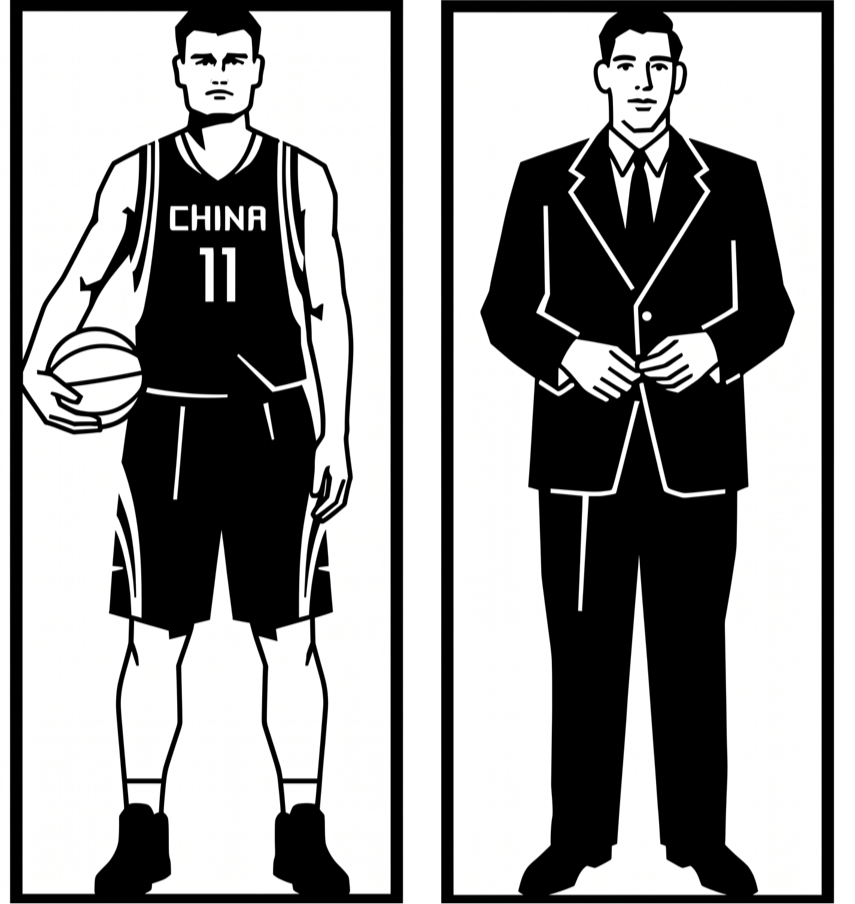
Yao Ming (left) and Robert Wadlow (right)
My Own Journey
I spent 45 years wondering why I was different from everybody I encountered. Social events were massive drains on my ability to function, but everyone else was having a good time. What was wrong with me?
I explained exactly how the CNC machine at work functioned, operating tolerances, how the parts interact, and the cabinet wiring diagrams, but they didn’t understand. What was wrong with them?
Sometimes after a long day, when my wife and I pulled into a busy restaurant parking lot, I found myself completely unable to enter, stress and anxiety screaming at me to not go into that busy environment. What was wrong with me?
Autism in the 80s
These events happened over and over. I was sure that I was different somehow, autism sounded like it had similarities to what I was experiencing, but I learned what autism was in the 1980s. Autism, as I learned of it at the time, were people who could not take care of themselves, they drooled, spoke incomprehensibly, beat their chests with their hands and had absolutely no autonomy. That was not me, that was also not autism as I’ve come to understand it.
The Architectural Mismatch
ASD as described in the Diagnostic and Statistical Manual of Mental Disorders or DSM is “a developmental condition characterized by persistent challenges in social communication and interaction, alongside restricted, repetitive patterns of behavior, interests, or activities” This seems like a description of what people are struggling with, not an actual pathology.
Modern neuroscience views autism not as a single localized defect, but as a complicated difference in whole brain architecture and neural connectivity. The autistic brain is understood to have a unique architecture that changes how sensory and social information is processed.
The Double Empathy Problem
The double empathy problem is the theory that miscommunication between autistic and non-autistic people is mutual, rather than a deficit solely caused by an autistic person lacking empathy. Proposed in 2012 by autistic researcher Damian Milton, it shifts the focus from an "autistic communication disorder" to a bidirectional disconnect. Historically, when a conversation between an autistic and a non-autistic person broke down, the blame and expectation to adapt were placed entirely on the autistic person.
The double empathy problem highlights how this dynamic impacts mental health. Dr. Milton challenged this blame by performing an experiment in the form of the “Telephone Game” between autistic and neurotypical people. Repeating whispered phrases down a line of people repeating what they heard the previous person until the last person spoke the phrase they heard out loud to the group.
The results showed that in mixed neurotype groups, the breakdown in communication was spectacular. However, both groups performed similarly when in same neurotype groups, essentially showing that autistic people don’t perform poorly at communication, they communicate just fine with people who communicate like they do. Similar to how someone who only speaks French isn’t bad at speaking, they just don’t speak English like you do. They communicate just fine with other French speakers.
Why the Tests are Rigged
These new breakthroughs in neuroscience were exactly the kick in the pants I needed to finally figure out what made me so different. I wasn’t a bad neurotypical person, I was an autistic person who didn’t have the extreme support needs that some people with ASD need to get through life. Doctors and therapists couldn’t help me, they only offered services for people with Autism Spectrum Disorder. My mental architecture was not a “disorder”, only a difference.
I spent 45 years figuring out how to make life work with my differences. I was a high masking, highly intelligent, very adaptable, very capable human being. Those facts made my autism different from ASD. I took some online autism tests, rolled my eyes at some of the questions like, “Do you know what ‘beating around the bush’ means?’” Well of course I know what it means, do you think I was born yesterday? It’s a nonsense collection of words that don’t mean anything when looked at like communication, but I’ve heard them enough to figure out what people mean when they say that phrase. [Form checkmarks-Not ASD]
“Do you keep your thoughts in a small box of index cards that you can read?” No, my memory works like this: A vast, swirling fog of paintings, some with characters from books, movies, some with diagrams of machinery, flowcharts of politics, maps of cities I drive in. When I think of what I need, I hold out my mental “hand” and the correct painting flies out of the fog and lands in my hand (most of the time). I can turn it over, look at notes written on the back of the painting, blow up the visuals, manipulate them, and apply physics and forces to the parts on the front. So, no index card box. [Form checkmarks-Not ASD]
The Yao Ming vs. Wadlow Analogy
I like to think of the difference between autism and ASD like Yao Ming (basketball player 7’6” tall) and Robert Wadlow (former world’s tallest man 8’11” tall). Both of these men had problems with doorways, kitchen counter heights, bed lengths, and social differences from their height. Robert Wadlow’s height was complicated with many health issues and support needs. He needed a doctor’s assistance, used leg braces and needed support people to help him live as normally as he could.
Yao Ming had some of the same struggles, but with fewer support needs. Nobody would say that Yao Ming is not tall because he didn’t meet the criteria of it being a disability. He has his own struggles, even if it doesn’t meet the diagnostic threshold. Yao’s difficulties are not diminished because other people have a more troubling experience, just like autistic people who don’t meet the medical criteria for ASD have authentic struggles with their lives too.
Mapping the Architecture
“The diagnostic threshold for 'Disorder' is a measure of the support needs required to survive, not a measurement of the presence of autism itself.”
If you know you are autistic but don't see yourself in the disorder framework, you aren't alone. I’m building a systems-based approach to thriving that doesn't rely on being 'fixed'. If you'd like to see how I've audited my own architecture and can help you map your own, explore the Life Audit framework here.
